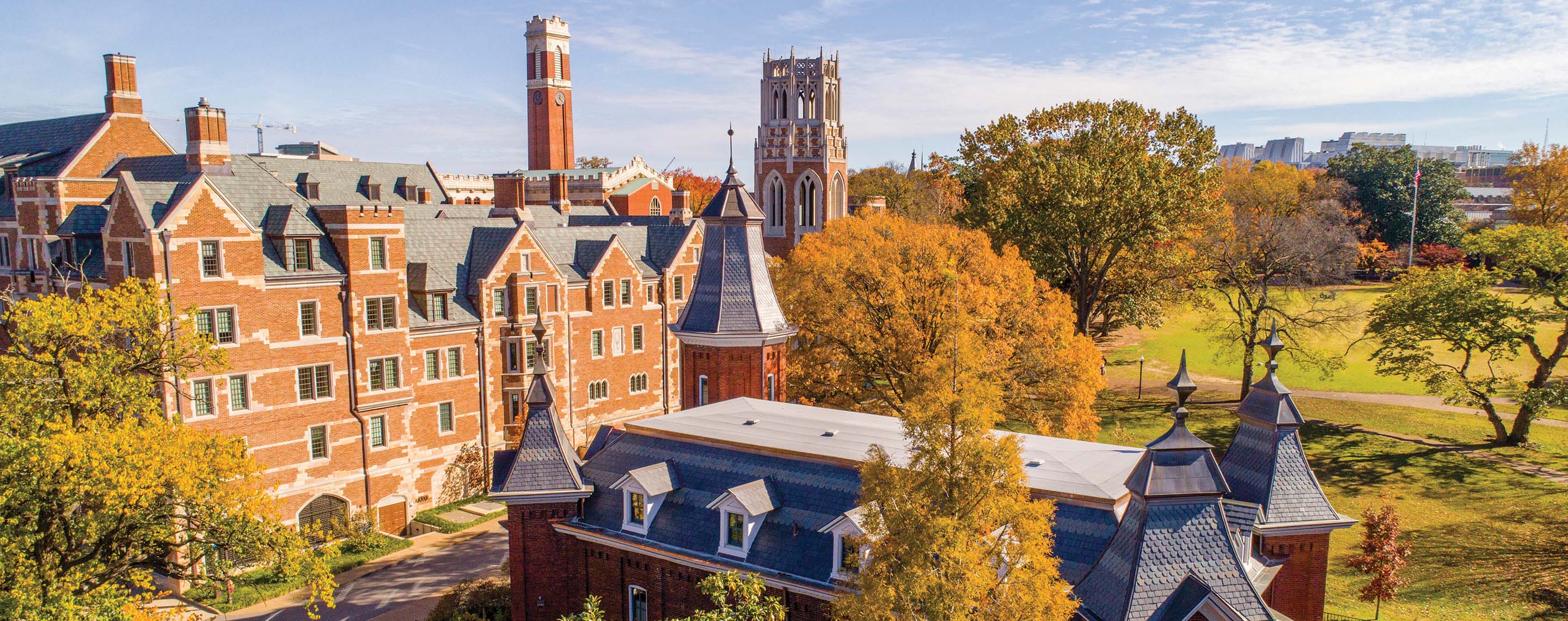
Vanderbilt is the rare school that takes academic seriousness and sheer fun equally seriously. People sometimes call it "the most fun Ivy" — not an actual Ivy, but the yield numbers tell you the joke is closer to truth than not. Students cross-admitted with Penn, Brown, and Duke pick Nashville at impressive rates, and once you understand what Vanderbilt is actually like on the ground, you stop being surprised.
The catch is that getting in is hard, and the application has more moving parts than most people realize. You're not applying to Vanderbilt the way you apply to a big public flagship. You're applying to one of four distinct schools, possibly to a separate full-tuition merit program, and you have to convince admissions you'll thrive in a place where students go to a basketball game, debate Heidegger over brunch, and catch a Bridgestone show that night — without making any of those three things sound like a costume.
By the numbers
| Metric | Detail |
|---|---|
| Acceptance rate | ~5.9% |
| SAT middle 50% | 1480-1560 |
| ACT middle 50% | 34-35 |
| Testing policy | Test-optional |
| Letters of rec | 2 teachers + 1 counselor |
| Supplement | One ~250-word short response |
| Interview | Not offered |
| ED I deadline | November 1 |
| ED II deadline | January 1 |
| Regular Decision | January 1 |
| Financial aid deadline | February 1 |
A few things worth saying out loud about these numbers. The acceptance rate has dropped sharply in the last decade — Vanderbilt was at 12% as recently as the late 2010s. The middle-50 testing band looks similar to Ivies because applicants are similar. And test-optional is real here: a meaningful share of admitted students apply without scores. If your testing is below the 25th percentile, applying without scores is a legitimate strategy, not a workaround.
Choosing your Vanderbilt school
You apply to one of four undergraduate schools. You can't apply to two and you can't hedge. Picking the right one is part of the application.
Arts & Science (CAS) is the largest school and the default for most applicants. Humanities, social sciences, hard sciences, pre-med, pre-law — if you're broadly liberal-arts inclined or you genuinely don't know your major yet, CAS is the right home.
Peabody College is education and human development. Don't read "education" narrowly. Peabody includes child studies, cognitive studies, human and organizational development (HOD — a popular interdisciplinary major touching psychology, sociology, and business), special education, and more. It's consistently ranked the top graduate school of education in the country, and its undergraduate programs benefit from that gravity. Apply here if you're drawn to how people learn, develop, and organize themselves — not only if you want to teach.
Vanderbilt School of Engineering is what it sounds like, and it's strong without being the kind of cutthroat engineering culture that grinds people down. Biomedical engineering is the standout, paired tightly with the medical school. Computer science, mechanical, electrical, and chemical engineering all have serious depth.
Blair School of Music is a conservatory inside a research university, which is a rare combination. You audition, and admission is significantly about that audition — your academics need to be solid, but the bar there is different than CAS or Engineering. Blair students often double-major with another school, which is part of the appeal.
The right move: pick the school you'd actually want to be in for four years, not the one with the highest published acceptance rate. Admissions reads each school separately, and they can tell when an applicant has wandered into Peabody trying to game the odds.
What Vanderbilt actually values
Three things, in roughly this order.
Fit with your school of choice. Your application has to make sense for where you're applying. A Peabody applicant should be visibly curious about how people develop and learn. An Engineering applicant should have a track record of building, breaking, or analyzing things. CAS gives you the most range, but even there, the strongest applicants have a clear intellectual center of gravity.
Intellectual depth without performance. Vanderbilt loves students who go deep. They're suspicious of resumes that look like a checklist of every "impressive" activity. One serious thing pursued for years beats six things spread thin. Original research, sustained creative work, a club you actually built rather than joined — these read better than a 12-line activities list of presidencies.
Social engagement. This part is real. Vanderbilt prides itself on producing graduates who are present in the world — engaged with their classmates, involved in causes, and not allergic to fun. Greek life is genuinely large (around 30-35% of undergrads), athletics are SEC, and traditions like Rites of Spring matter to students. You don't need to be a future fraternity president, but the application should suggest you'll show up — not just to lab, but to your hall, your team, your friends' performances.
Application requirements
You'll submit through the Common Application, Coalition with Scoir, or QuestBridge. The required pieces:
- Common App personal essay (650 words). The same one you're sending to most schools.
- Vanderbilt supplement — one short response of around 250 words. The current prompt asks you to elaborate on how one of your extracurricular activities or work experiences has influenced you, or to discuss your involvement with your community.
- Two teacher letters of recommendation, ideally from junior-year academic teachers in core subjects (or in subjects directly relevant to your school — a music teacher for Blair, a math/science teacher for Engineering).
- Counselor letter and school report.
- Transcript through the most recent grading period, with a mid-year report following in the winter.
- Test scores, if you choose to submit. Self-reported is fine for application review; official scores are required if admitted and enrolling.
- Audition (Blair only).
- Portfolio (optional, for applicants in relevant fields — there's a SlideRoom for the arts).
Then there are the merit scholarships, which most applicants don't realize until late. Vanderbilt has three signature programs — Cornelius Vanderbilt Scholarship (full tuition plus a summer stipend), Ingram Scholarship (full tuition plus service-learning funding), and Curb Creative Scholarship (partial tuition for arts-focused students). The Chancellor's Scholarship covers full tuition for students committed to civil rights and social justice work. Each requires a separate application, with extra essays, due in early December for most. If you're a competitive Vanderbilt applicant, applying for these is essentially free upside — just plan for the time.
The Vanderbilt supplement: how to write it
You get roughly 250 words. That is not a lot. Your goal isn't to summarize the activity; it's to show admissions a particular angle of how you think and operate.
Pick one activity. Just one. The applicants who try to gesture at three or four end up saying nothing about any of them. The activity doesn't have to be the most impressive thing on your application — the founder-of-a-nonprofit response is often weaker than the marching-band-section-leader response, because the latter usually has more specific texture.
Lead with a moment, not a summary. Don't open with "Throughout my four years on the debate team..." Open with the round you lost in October, or the conversation you had with a freshman teammate at 11pm before regionals. Specificity buys you trust; trust buys you the rest of the essay.
Then earn the back half by reflecting on something real. What changed in you because of this thing? What did you misunderstand at first? What have you noticed about yourself, or about the people you do this with? Reflection is the part most students skip or fake. Don't.
Avoid the activity that anyone could have written about — varsity captain leading the team to victory, mission trip changed my perspective, mock trial taught me public speaking. If your draft sounds like it could go on anyone's application, reset.
A good gut-check: would your closest friend recognize you in this essay? If not, rewrite.
Standing out
Concretely, what does a strong Vanderbilt applicant look like?
A junior who runs original chemistry research with a local university lab, presents at a state symposium, and writes their supplement about a botched titration that taught them something about patience. Or a student who's the lead arranger for an a cappella group, has built a small library of their own arrangements, and applies to Blair with an audition tape that sounds like them, not a recital. Or a debater who turned their team's politics-and-podcasting curriculum into a six-school regional network — they don't list it as "founder," they list the schools.
The pattern: real depth, demonstrable output, a story you can tell in a paragraph.
For merit scholarships specifically, the bar is higher on impact. Cornelius Vanderbilt finalists tend to have done one or two things at a level where adults paid attention — published, performed, organized something with measurable scale. The Ingram skews toward sustained service with a clear thesis behind it (not just hours). The Curb wants creative output with a body of work behind it, not a single project. Apply, but apply seriously — these aren't lottery tickets.
Quick tips
- Apply to the right school the first time. You can request a transfer between schools after enrolling, but Admissions evaluates you as a Peabody (or Engineering, or CAS) applicant, and the wrong fit hurts you.
- Don't waste the supplement on a victory lap. Pick the activity with the most thinking behind it, not the most prestigious title.
- ED is meaningful here. Vanderbilt's ED acceptance rate is roughly double the RD rate, and the school takes ED commitments seriously. If Vanderbilt is genuinely your top choice, ED I or II is a strong move.
- Submit the merit scholarship app. Even if you think you won't win, the application is a forcing function for sharpening how you talk about yourself — and someone has to win them.
- Use Nashville in your essays only if you mean it. "I love Nashville" reads as filler. "I want to study music industry policy in the city where the policy gets written" reads as fit.
- Talk to a current student before ED. Vanderbilt's culture is specific — Greek-heavy, residential, social, Southern-inflected. Make sure it's the place you want, not the place that looks good.
If you do all of this right, you'll have an application that looks like a person — a specific person, with a center, who would clearly thrive in Nashville. That's what Vanderbilt is reading for.