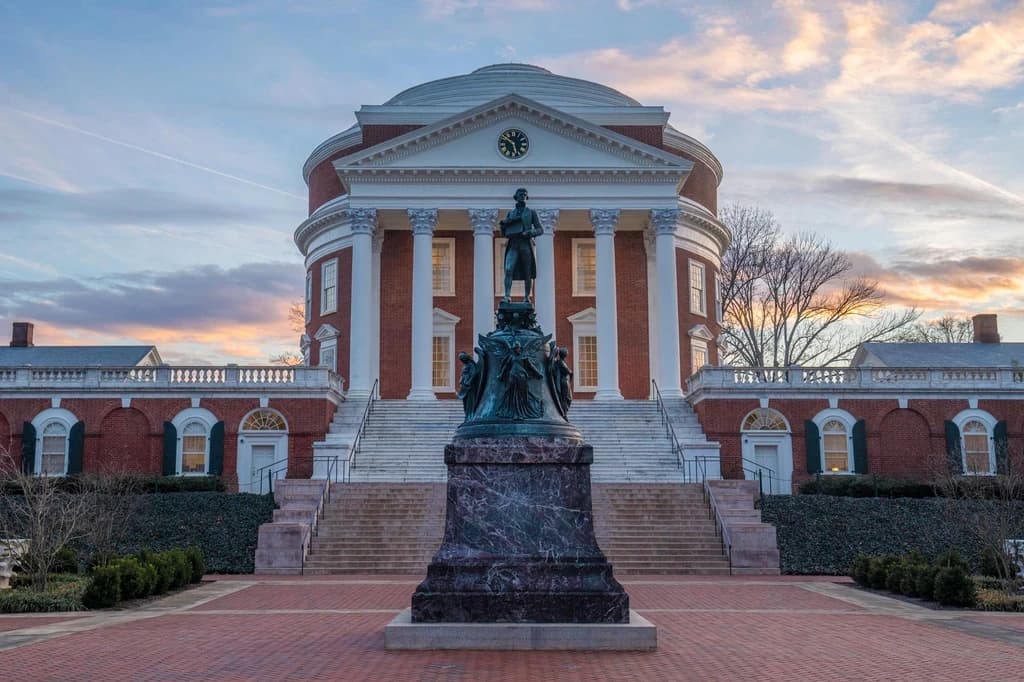
The University of Virginia is a public school in name and a Public Ivy in practice. It admits roughly 16% of applicants overall, and the OOS pool is admitted at closer to 13%. If you are reading this, you should be planning your application like you would plan one for Duke or Cornell, not like you would plan one for a flagship state school. The bar is high, the writing matters, and the structural details of how you apply (which school you pick, when you submit, what you say in the short answers) shape your odds more than most applicants realize.
This guide covers what UVA actually wants, how the in-state and out-of-state games differ, and how to write the supplements without sounding like every other applicant in the pile.
By the numbers
| Detail | |
|---|---|
| Acceptance rate (overall) | ~16% |
| Acceptance rate (in-state) | ~24% |
| Acceptance rate (out-of-state) | ~13% |
| SAT middle 50% | 1380–1510 |
| ACT middle 50% | 32–35 |
| Testing policy | Test-optional |
| ED deadline | October 15 |
| EA deadline | November 1 |
| RD deadline | January 5 |
| Recommendations | 1 teacher LOR + 1 counselor (only one teacher is unusual) |
| Application platforms | Common App or Coalition App |
A few things to notice. The ED deadline is October 15, which is earlier than most schools. EA is November 1. Both are non-restrictive in the sense that EA is non-binding, but ED is a real commitment. And the testing range is high enough that "test optional" should not be read as "tests don't matter." If your score lands in or above that middle 50%, send it.
In-state vs out-of-state: a different game
UVA is a Virginia public university with a state mandate, and that shows up in the admit math. About two-thirds of every freshman class is Virginia residents. The OOS rate sits in the low teens, and OOS applicants tend to be reading and writing at a level that rivals what private peers see.
If you are in-state, the practical implication is not that admission is easy — it is that the floor for being competitive is lower, but the ceiling on what gets you in is roughly the same. A B+ student from Virginia with strong context and a tight application gets a real look. The same student from California probably does not.
If you are out-of-state, you are competing in something closer to a private-school admit pool. Expect to be measured against students who could be admitted to any top-25 school in the country. Your application needs to read like one of theirs — sharp essays, a clear academic identity, leadership that is more than a list of titles, and a real reason you want UVA specifically and not just a "good school in the South."
International applicants are read in a similar bucket to OOS, with admit rates that tend to run a touch lower still. Strong English-language testing and clear context for grading scales help.
What UVA actually values
Three things, in roughly this order:
Fit with the specific school within UVA. You apply to a particular undergraduate school: the College of Arts & Sciences, the School of Engineering and Applied Science, the School of Architecture, the School of Nursing, or the Kinesiology program. (Commerce and Education admit later, as internal transfers.) Admissions reads your file with that school in mind. An Engineering applicant whose record and essays read like a humanities student is a confused applicant, not a versatile one. Pick the school that genuinely matches your trajectory and write to it.
Intellectual seriousness. UVA likes students who think for a living, not students who collect activities. The supplements are designed to surface this — they ask about a course you would create, a topic you could speak about for an hour, a word you love. The quality of mind on the page matters more than whether you have the "right" topic.
Character, with the Honor System in the background. UVA's Honor System is a single-sanction student-run code that has been part of the school since 1842. You do not need to write about the Honor System in your essays, but you should understand what it implies about the place. Admissions reads for students who can be trusted with that level of self-governance: students who tell the truth about hard things, who take responsibility, who are not chasing prestige for its own sake.
Application requirements
Submitting an application means assembling these pieces:
- The Common App or Coalition App, including the personal essay (one of the seven Common App prompts)
- The UVA-specific school question (the 100ish-word prompt that depends on the school you apply to)
- One short answer chosen from a small set of UVA prompts (~250 words for the longer form, with shorter quirky options at ~50 words depending on year)
- One teacher letter of recommendation
- One counselor letter and the school report
- Transcript
- Optional: SAT or ACT scores
- Optional: mid-year grades, art portfolio (Architecture), or program-specific materials
Note the recommendations: UVA asks for only one teacher letter, where most peer schools ask for two. That single letter is doing more work than usual. Pick a teacher who knows you well, has taught you in a core academic subject (preferably junior year), and can speak to how you think — not the teacher who gave you the highest grade.
Deadlines, in order: ED October 15, EA November 1, RD January 5. ED commits you. EA does not. Financial aid materials are due March 1.
UVA essays: how to write them
There are two pieces that require real attention beyond your Common App essay: the school-specific question and the short-answer choice.
The school-specific prompt. This is short — about 100 words — and it is asking you to demonstrate that you have a reason to be in this particular school within UVA. The Engineering version asks how you would use an engineering degree to change the world. The College of Arts & Sciences version asks what college course you would create. The Architecture and Nursing versions ask about a specific experience that pulled you toward the field.
The mistake almost every applicant makes is to write something abstract and uplifting. "I want to use engineering to solve climate change" is not an answer. It is a tagline. You have 100 words. Use them on something concrete: a project you built, a question you have been chasing, a specific course or professor at UVA whose work overlaps with yours. The reader is trying to figure out whether you actually belong in this school. Show your work.
The short-answer prompt. UVA gives you a list to pick from, and the quirky ones (your favorite word, your happy place, your Beta Bridge message, a topic you could speak about for an hour) are designed to let your voice come through. The trap here is performing — picking the prompt you think sounds smartest, or the one you think reveals the most "depth," and then writing toward that target.
Pick the one where you actually have something to say. Then write it the way you talk. The best UVA short answers feel like the applicant sent a text to a friend, not a college essay to a committee. Specificity, not profundity, is what makes them work. "My favorite word is 'oblong' because it sounds like the shape it describes" beats "My favorite word is 'resilience' because of what I have overcome" every time.
A good gut check: read your answer aloud. If it sounds like something a parent would write, rewrite it.
Standing out
For UVA in particular, three patterns work well.
Real research, not "research." A summer program where you sat in a lab and watched is not research. A meaningful investigation — even a small one, even one that did not lead to publication — that you can describe with specificity is. Engineering and A&S applicants especially benefit from being able to talk about a question they pursued for more than a few weeks.
Leadership that produced something. Titles do not impress UVA admissions. Outcomes do. If you ran a club, what did the club look like before and after you ran it? If you started something, who showed up and what did it become? One specific story you can tell beats a list of five vague positions.
Deep specialization in one area. UVA likes students with a center of gravity. If you are a writer, your application should read like a writer's. If you are a builder, it should read like a builder's. The well-rounded applicant who does eight things at a B+ level reads thinner than the applicant who is genuinely excellent at one or two things and has the work to show for it.
Quick tips
- Apply to the right school within UVA on day one. Switching internally later is possible but not guaranteed, and writing the supplement for the wrong school is a waste of your strongest material.
- If you are out-of-state, ED is worth considering. The admit-rate bump is real, and committing early signals fit in a pool where fit is the variable that moves applications.
- Send scores if they are at or above the middle 50%. Test-optional is a true option, not a recommendation.
- Use the 100-word school prompt to name something concrete at UVA — a course, a professor's research, a program. Generic answers read as generic.
- Pick your single teacher LOR with care. A junior-year core-subject teacher who has watched you think is the right call.
- Read your short answers aloud before submitting. If they do not sound like you, they will not work.